


As a seasoned Gopher, there are a lot of things that I have found out about throughout my time at Goucher that have been found not through orientation or campus-wide emails but late nights scouring the college website and off-hand hallway conversations. As everyone comes back to campus for the fall semester, and we welcome 245 new students and 22 international exchange students, I want to make sure that people are aware of all these resources I’ve stumbled across. Here is a non-exhaustive list of the things nobody tells you about at Goucher:
- Goucher’s Emergency Fund: Also known as the Janet Cane Fisher‘38 Fund, this fund exists to help students going through immediate crises such as severe injury/unexpected medical costs, need for emergency housing and food, or family emergencies. This fund specifically covers emergency aid, and
is not applicable for general school-related funding or non-essential expenses. Be aware that students can only receive funding once per semester. For more information check out this page! - Medical Transport Program: A helpful resource for students getting non-emergency physical or mental health treatment off-campus. It is a program jointly run by CREI, the Office of Title IX, Student Wellness, and the Student Counseling Center that provides free transportation to medical appointments through Uber. To read more and request transportation look here!
- Barrier Report Form: Accessibility is an ever-ongoing process that relies on people pointing out inaccessibility. On-campus this means making sure that people are aware of physical, electronic, or program-related barriers on campus. This can include broken push-buttons for doors, out-of-service elevators, websites with poor contrast or that are not screen reader friendly, and anything else preventing use of an academic building or service. When you encounter barriers on campus, reporting them via this form allows for the problem to be documented and addressed. It also means that there is an electronic paper trail that can be used by student leaders, student advocates, and college staff to continue arguing for long-term accessibility improvements. You can report a barrier here. Please consider saving this link to your phone or computer for easy access.
- Gluten Free Pastries at StuMar: For my fellow gluten-intolerant and celiac friends, there are a few pastry options for Pick 3 for you. While not displayed in the main pastry case, Bon Appétit has offered gluten free brownies and gluten free chocolate chip cookies for the past three years. If you need one, simply go up to the counter and ask one of the workers, if the workers don’t know where they are (because not all of them do) ask them to check the top tray of the sheet pan rack.
- Third Spaces: Having places on campus that are inherently study spaces or living spaces are important. Here are a few of my favorite places:
- CREI: The Center for Race, Equity, and Identity is an office that focuses on events and programming for all students, and is stated to work “specifically [with] students of color, LGBTQIA+ students, and disabled students/students with disabilities.” While the office is only open for limited hours, primarily on week days, the CREI office has a multitude of tables and couches that can be used by students, as well as a TV, conference room, and coffee machine. It is located on the bottom floor of the Ath, past the campus store.
- SGA Office: Located to the left of Mary Fisher’s main entrance the SGA Office sports numerous couches and comfy seats to study, socialize, or strategize.
- Ath floor space: Beyond the library and the Hyman forum there are a lot of little corners and nooks within the Ath. Different floors offer different vibes–the bottom floor has standard table and chair set-ups, the second and third floors offer an assortment of couches and chairs, and the third floor features a couple of free standing workout machines where people move while taking in the comings-and-goings of other students.
- Goucher Woods: Goucher has an ample amount of hidden corners within the fields and woods that make up our campus. It is well-worth the wander to explore and find a spot that calls to you.
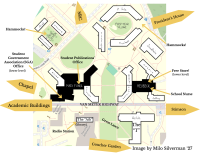
- Gazebo: Located at the crossroads of the chapel, the Academic Quad, and Dorsey Center the gazebo provides a nice place to sit and take a breather, to people-watch, or to observe campus at night.
- The Van Meter Recording Studio: A personal favorite of mine, the basement of Van Meter boasts a full size recording studio. This space does require prior permission and training due to the amount of equipment in the room, but it allows for musically-inclined students to record projects for classes and
get experience working with professional recording equipment. - Donnybrook: For my fellow junk-journalers, nostalgia-lovers, and sentimentalists there is Donnybrook the Goucher College Student Yearbook. While currently inactive, Donnybrook allows students to capture their perspectives and memories of life at Goucher for themselves and future students. Interested in the revival of Donnybrook? Reach out to the Q and let us know!
- Capstone Day and the Goucher Symposium: Happening once a semester this is an opportunity to share your research with the campus community and to hear what your peers have been working
on. It provides a uniquely interesting look into the passions and motivations of Goucher’s current students. Students of any year can sign up to present, and there are multiple possible formats. - Free Plan B: The Health Center is providing free Plan B this semester. If you or someone you know is in need of some, you can obtain it by making an appointment with the nurse during the Student Health Center’s open hours which are 9am to 5pm while classes are in session.
By RAR ’28




Be First to Comment