

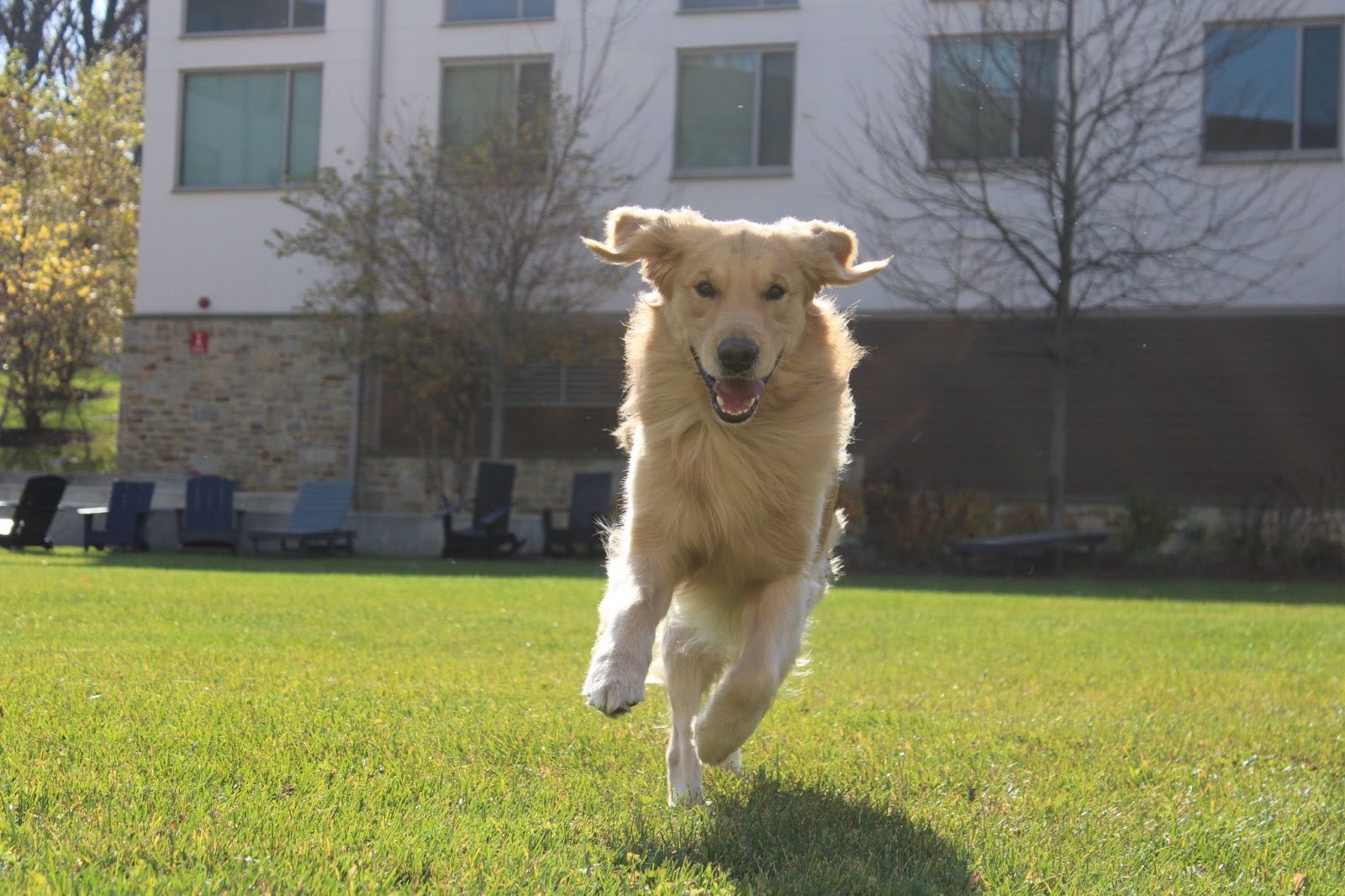
You may have occasionally seen Goucher’s unofficial mascot roaming along Van Meter Highway or exploring the halls of the academic quad. This five-year-old golden retriever, Paima, is a hard-working service dog who is just as helpful as he is cute. Paima can usually be seen with his owner, Em Klein-Luce, a junior undergraduate student at Goucher College, who I sat down with for an interview.
Finding and training a service dog is not an easy task, and requires an immense amount of dedication both on the behalf of the dog themselves and the trainer as well. Em decided to get a service dog after seeing others with similar medical conditions strongly benefit from having them. Combining both their career and health aspirations, they made the decision to work on training their own service dog.
50-70% of service dogs do not pass the training, mainly due to not being the proper temperament to be best suited for the job, but Paima has proven himself to be an extremely adept and smart dog. A big portion of training a service dog is simply finding the right dog, one that has the proper energy level, drive, and focus. Em says that they got really lucky with Paima, as he was “perfectly suited to be a service dog.” Paima was part of a litter of puppies bred from a long line of excellent service dogs.
Paima and his litter of siblings were put through temperament testing at just seven weeks old, which included testing the puppies’ responses to a Tickle Me Elmo doll. Ideally, you want a puppy that is not afraid of the toy and that would be curious enough to walk up to it, then ignore it. The moment Em knew that Paima was going to be the right dog for them was after Paima ran up to the Tickle Me Elmo, grabbed it by the ear, and started dragging it around the room. This display of confidence and grit was the opposite response of the majority of the puppies in Paima’s litter. Em said Paima had the amount of “spiciness [they] needed in a dog,” and also showed he would be a bit of an interesting challenge. As expected from his initial seven week test, Em described the training process as both “more fun than you can imagine, and incredibly stressful and challenging.”
Paima is task-trained in many things “too many to name,” according to Em. He primarily works in both psychiatric and mobility tasks, including item retrievals, where he picks things up from the ground and brings them to his owner’s hands. His favorite, and easiest task for him to learn, is deep pressure therapy, in which he is cued to lay down on his owner’s lap. The pressure calms the nervous system, but to Paima this is “just snuggling.”
Contrastingly, the most difficult task for him to learn was forward momentum pull. This is only done with a properly fitted forward momentum harness and involves pulling his owner along to maintain stability. It is primarily used to assist “with walking or initiating movement from a stationary position,” according to Partners Dogs, a service dog training website.
This task is not terribly difficult for the dog, but requires a lot of careful research on behalf of the trainer. In order to get approved to do this task, there had to be two sets of x-rays done and approved by a board of veterinarians before even beginning training. The amount of pressure required during this action can be detrimental to a dog’s joints if not done properly or if it is performed by a dog with underlying conditions. This includes a well fitted harness, the proper build and strength for this task, and a sense of directional and balance skills that cannot be taught in a dog. Em said that the process was not terribly difficult, “just really time consuming and you have to be very precise.”
“There were a lot of challenges training, but because he was so set up for success, I never doubted that he was going to succeed as a service dog,” Em explained. Paima is more than just hard working, and when he is off-duty, he is a goofball with a “zest for life.” Em even goes so far as to say that “food is his number-one motivator, and some days I think his love for me comes as a secondary one.” He can be seen giving killer puppy-dog eyes for chicken tenders in the student market at least once a week. Em always says for Paima, “every single day is the best day of his life so far, and he can’t imagine that it would get better, but that it always does.” Paima loves his job, and he’s “really f**king good at it.”
Photo Credit: Em Klein-Luce




Be First to Comment