

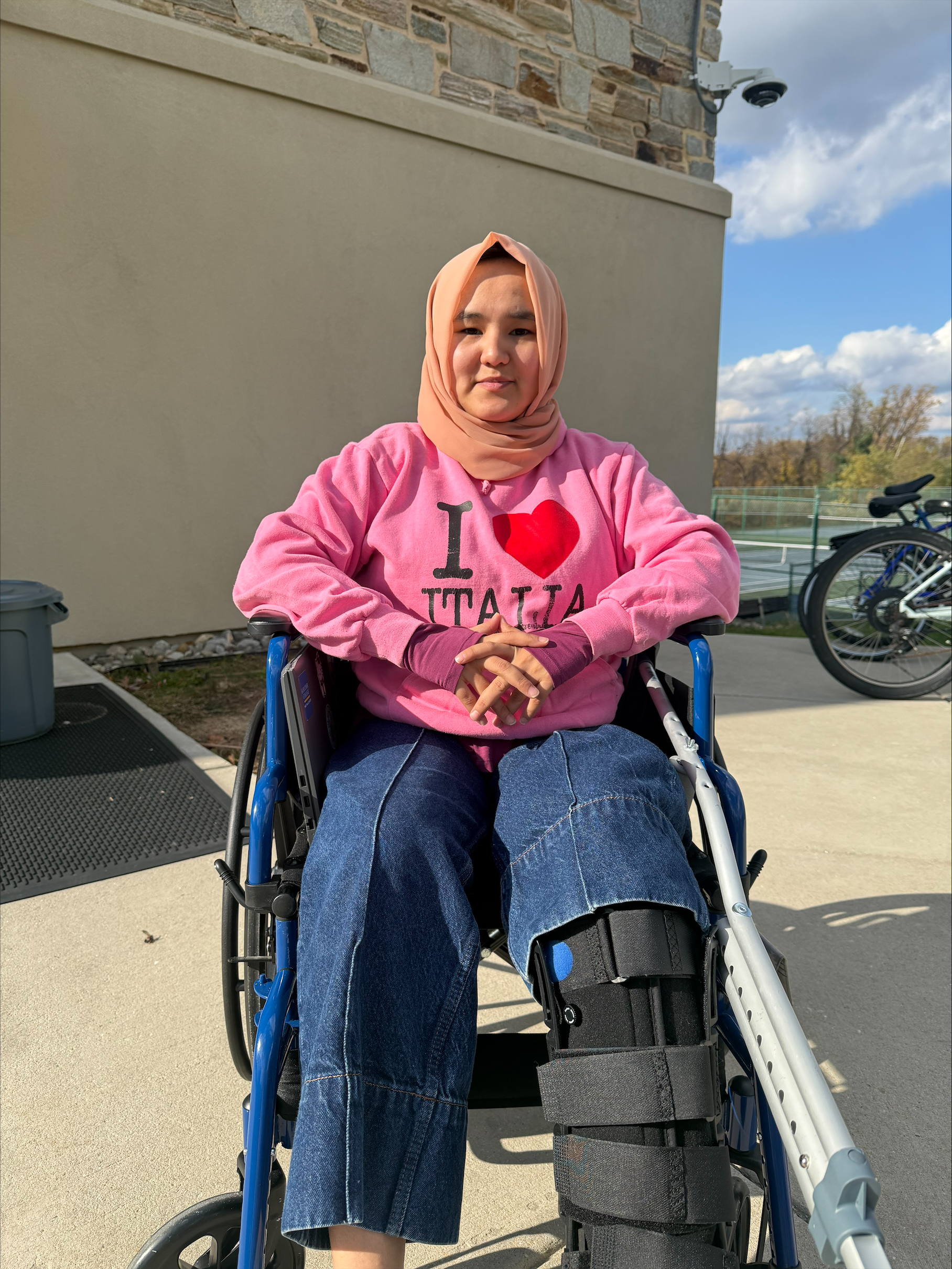
Goucher College is known for its wide range of accommodations and its strong commitment to supporting students with disabilities and other needs. However, one student’s story speaks to the need for Goucher to expand its services for temporarily disabled students.
On October 22, 2025, Haseen Amini (‘28), an International Student originally from Afghanistan, fell from the stairs in her dorm and broke her ankle. Upon the injury, Haseen immediately called her friends and Campus Safety, who called the ambulance. Campus Safety said it would have someone escort her to the hospital, but Haseen claims no one from the school showed up while she was hospitalized.
Thankfully, her friends supported her through this intense situation. While at the hospital, Haseen was given painkillers, crutches, and a boot. Doctors said it could take her up to twelve weeks to walk again.
When Haseen returned from the hospital, the Office of Accessibility (OAS) relocated her housing from the second floor of Tuttle to the 1st floor of Alcock, as she could no longer easily move up and down stairs. That night, Haseen had high blood pressure due to the severity of her situation. She also wished staff would have checked in on her the couple days she was bedridden because she felt alone.
At the beginning of her injury, Haseen quickly decided to travel via wheelchair because she had fallen multiple times while trying to use the crutches, causing further pain to her already broken ankle. She called the Student Health Center and was told it did not have wheelchairs for students, so she borrowed one from a friend. As you can imagine, operating a wheelchair by yourself can be a hassle. She stated she was more aware of hills and ramps because they were difficult to navigate. Going up was a challenge, and coming down wasn’t a walk in the park either because her wheelchair didn’t have any brakes.
Frustrated and still unable to get around effectively, Haseen reached out to various college resources, including the OAS, Campus Safety, the Academic Center for Excellence (ACE), and the Student Health Center, requesting transportation or an escort to and from classes; however, each department denied her request. Haseen recounts going back and forth between Campus Safety and the OAS.
According to Haseen, the OAS stated that it provides only housing accommodations and that Campus Safety is responsible for transporting students around campus. Haseen then contacted Campus Safety, which initially said it didn’t have the proper vehicle to escort her. Haseen then noted that she would be willing to accept another vehicle. Still, Campus Safety allegedly replied that it only escorts people at night if they are afraid to walk alone in parking lots. This left Haseen unable to attend classes during the early stages of her injury. Additionally, during these early stages, she was primarily reliant on her friends to get her to and from class.
However, Haseen didn’t like constantly asking people to help her get to class, so she would push herself with her uninjured leg. Using her uninjured leg, she’d push off the ground and navigate all at once, and she used her arms to push the wheels to give her more power. As you can imagine, she struggled a lot! Especially since Alcock is at the bottom of a hill and all the class buildings are at higher elevations, every day was a challenge, but she pushed through. However, on occasion, during her journeys to class, she couldn’t help but notice the facilities and Campus Safety vehicles that would drive past her.
Furthermore, Haseen had medical appointments for her ankle. Her first appointment was in Baltimore, and she was able to attend easily because of the Medical Assistance & Transport service Goucher offers. This service provides non-emergency transportation to physical or mental health-related appointments for students within a 15-mile radius of the College. However, her second appointment with the specialist was outside the 15-mile radius, so she had to pay for an Uber to get to and from the appointment.
A couple of months went by, and Haseen began to heal from her injury and was no longer reliant on the wheelchair, but occasionally needed crutches when she got tired. She called the Student Health Center requesting another pair because the ones the hospital gave her were too small.
As she spoke with the Student Health Center representative on the phone, she was told that wheelchairs are available to students free of charge. She was fed up with Goucher’s departmental lack of communication and miscommunication. The Student Health Center did not have the size of crutches she needed, so she had to continue using the undersized ones from the hospital, which did cause her back pain. This whole process caused her a great deal of frustration, anxiety, and feelings of isolation.
Haseen wasn’t the only student to injure themselves this school year. About a month ago, Goucher student-athlete Olivia Barnes ‘27 slipped on ice one night while walking outside the Student Market. As a result, she broke her ankle and is using crutches to navigate campus. Fortunately, Olivia is having a much better experience than Haseen. When asked, “Has the school provided any assistance or resources for you so far?” She replied, “Oh, absolutely…” and went on to talk about how the Student Health Center provided her with her first set of crutches. All in all, Olivia is satisfied with her accommodations and only wishes classes were closer, as the journey from her dorm to class can be tiring, so she frequently stops to rest. On Tuesdays and Thursdays, she says it takes her 20 minutes to walk to class.
I reached out to Campus Safety and OAS for clarification on their roles and responsibilities and for a comment on Haseen’s situation. Campus Safety director Tiffany Justice said they are not a medical transport service. Therefore, their vehicles are not equipped to transport injured individuals. Moreover, she said that their responsibility when students express injury is to “assess the situation, ensure immediate safety, and facilitate appropriate medical care by contacting emergency medical services or other qualified providers when necessary.” Campus Safety fulfilled its responsibilities by calling the ambulance. Justice stated that their escort service is “not designed to serve as transportation for injured individuals or as ongoing mobility assistance,” which begs the question: Should there be a service for temporarily disabled students that can transport them to and from class? When I emailed the Office of Accessibility, I acknowledged that they had re-housed Haseen but were unable to provide her with transportation to class. I asked them whether this is a service they provide for students. I received an email from the OAS that said there is a process for students who need temporary support due to injuries, included a link to Goucher’s Temporary Disability Services page, and then stated that they don’t have wheelchairs or any other mobility devices.
After speaking with Haseen, she revealed that she did not follow Goucher’s official process for obtaining temporary accommodation, i.e., filling out the form on the Temporary Disability Services page. Her main method of communication was by phone calls and emails. This was a mistake on her part. However, even if she had gone through all the necessary steps —submitting the request for temporary accommodation form, meeting with OAS, and finalizing appropriate accommodations with her professors—these would have helped her in the classroom, not outside, and her main issue while wheelchair-bound was immobility.
On Goucher’s Temporary Disability Services page, it states, “ Depending on the nature of your impairment, you may need accommodations inside and outside of the classroom. Contact access@goucher.edu with any questions.” Its commitment outside the classroom should be specific as to what their roles and responsibilities are; if not to help students get to and from class, then what are they? Unfortunately, this vagueness left Haseen without the support she needed.
Furthermore, Goucher College is a recipient of Title IV federal funds; therefore, it is subject to the ADA and Rehabilitation Act, which applies to all institutions that receive federal funding. These laws are NOT based on citizenship and protect anyone who participates in programs or activities covered by them. For example, if a non-U.S. citizen goes to a college or university, they are entitled to these protections.
However, these protections only apply to conditions that are “sufficiently severe.” Schools and disability offices decide whether a temporary condition is “sufficiently severe” based on whether it limits significant life activities, academic functioning, and whether there is medical documentation. Without question, Haseen met these conditions, and so have and will other temporarily disabled students with leg and ankle injuries. So, one must wonder why there isn’t any transportation service for such students.
Overall, Goucher needs to strengthen its temporary disability services to better assist students outside the classroom. There should be no reason that temporarily disabled students with reasonable injuries are unable to get transportation or an escort to class. Additionally, Haseen’s experience shows clear problems in how Goucher’s departments communicate. Instead of working together to help Haseen, OAS and Campus Safety kept redirecting her back and forth, and the Student Health Center did not provide her with a wheelchair when they had them the whole time. Since Goucher does not offer transportation to temporarily disabled students, Haseen didn’t fall under the jurisdiction of any college department or office; thus, leaving her in a bureaucratic gray area without the assistance she needed.
Additionally, Haseen’s situation highlights the emotional burden international students face when emergencies occur away from home. Without any nearby family to advocate for her, she relied entirely on her institution, and for many international students, colleges serve as their primary source of security, guidance, and stability. If that structure wavers, the impact is not only physical but also psychological. The anxiety and isolation Haseen described point to the need for Goucher to bolster the accommodations they offer temporarily disabled students.
Featured Photo Credit: Leila Townsend






Permanently disabled students do not have their needs or legal rights met either. Hopefully with enough student feedback, Goucher will address these failures.