


In response to aggressive immigration enforcement, communities across the country are banding together and coming up with action plans to keep their most vulnerable residents safer. The following is a compilation of information from various sources about the steps communities are taking and what you can do for your community here at Goucher.
Proactive And Reactive Actions
Preparing for potential future encounters with ICE is important. Having a plan in place can save a lot of time and energy, make emergency situations more coordinated, and keep the community safer. Ways to proactively prepare include:
- Know your rights
- Build a community response network
- Learn how to verify suspected ICE sightings and find people who can peer review sightings
- Have a plan in case of emergencies
- Campaign for a safer campus
- Know where to go for aid and be familiar with resources on campus
- International students: Save the contact information of a lawyer or immigration rights activist and share this info with a friend. Consult with the International Student and Scholar Services.
- Goucher’s initiative to lock all campus buildings and make them card-accessible only is an important step towards making this campus safer. Close any doors you see propped open. Don’t assist people who are trying to get into buildings if you don’t know them. Campaign to fix broken doors and onecard scanners, especially those in dorms and academic buildings.
- Assist vulnerable peers
- Share your skills; your creative abilities and personal knowledge can be used to help other
Reactive actions are a response to suspicious activity and confirmed sightings.
Campus Policy
Note: An earlier version of this article misrepresented Goucher’s current official campus policy on Immigration Enforcement Action. The current policy can be accessed here.
Bystanders should not physically interfere with ICE actions but are encouraged to know their rights and can film ICE activity if they choose to.
Know Your Rights
You have a right to:
- Privacy. ICE cannot enter private (residential) or limited access (academic) areas on campus without permission or a signed judicial warrant: 4th Amendment
- Remain silent. Refuse to sign documents or provide documents or personal info: 5th Amendment
- Seek legal counsel: 6th Amendment
- Refuse a search of your pockets and belongings; a pat down for agent safety shouldn’t include pockets
- Film the agents and their activity
- Ask questions
- Leave if you are not under arrest. Ask “Am I free to go?”. If the answer is YES, calmly walk away. If the answer is NO, say “I will not answer any questions. I want to speak to a lawyer.”
- When in doubt, say “I do not consent”.
If ICE pulls your vehicle over, all general rights apply. Additionally, you have a right to:
- Refuse to be fingerprinted unless you are under arrest
- Refuse a search of the car
- Ask agents if they have a warrant (know the difference between a judicial and administrative warrant)
- Vehicle passengers have a right to refuse to show an ID, but the driver does not
Community Defense Network
A community defense network is a system of like-minded individuals who want to defend their neighbors. The primary goals of these communities are to inform others and to use proactive and reactive actions against ICE. The building blocks of a network are as follows:
- Create a communication system with like-minded peers; communication trees are a good option
- Train people how to identify ICE, as well as how to respond, organize, recruit others to the community network
- Distribute “Know Your Rights” info
- Create an emergency rapid response plan, including a system to detect, confirm, and react to ICE activity
Safety And Privacy
If you encounter ICE in person, conceal your identity: Wear a face mask. Cover identifying markings (hair, tattoos, clothing that reveals personal info, etc).
Disable biometrics or enable Lockdown mode. Agents need a judicial warrant to confiscate and search a device, but it’s easier for them to bypass this if biometrics are active on your devices.
Use encrypted messaging. The DHS has been trying to identify Americans who oppose ICE operations. Be careful what you post on platforms like Google, Reddit, Discord, Facebook, and Instagram. Consider alternatives that offer end-to-end encryption or better privacy standards like Signal, Protonmail, Element, and more.
Additional online safety measures include turning off location permissions, getting a VPN, turning on “disappearing messages”, applying updates to your phone as soon as they’re available, and rebooting your devices often.
Identifying ICE Vehicles
ICE typically uses unmarked vehicles which are hard to identify. Unmarked vehicles belonging to ICE COMMONLY have the following features:
- Opaque tint on driver and passenger windows
- Aggressive driving
- Moving in groups of 2 or more
- Neutral colors
- Recent models (newer than 2020)
- Can have missing license plates, in or out-of-state plates, or “Exempt” “DHS”
- Interior fencing between the front and back
- Sometimes have police lights mounted on the grill or windshield
- Typically American car manufacturers like Fords, Dodges, and Nissans
Do not assume that the vehicle you see belongs to ICE. Always get a sighting verified.
Vehicles that are UNLIKELY to belong to ICE often have the following features:
- Transparent window tint
- Excessive dirt or salt
- Spotlights or antennas
- Luxury car makers and models
- Non-US car makers
Vehicles that DO NOT belong to ICE often have the following features:
- Maryland Park Police plates
- Visible police lights while driving, idling, or parked
- Bumper stickers, dashboard decor, air fresheners
- Roof or bike racks
- Older models (older than 2020)
ICE rarely uses clearly marked vehicles, but when they do, they typically look like this (note the ICE logo and agency name):
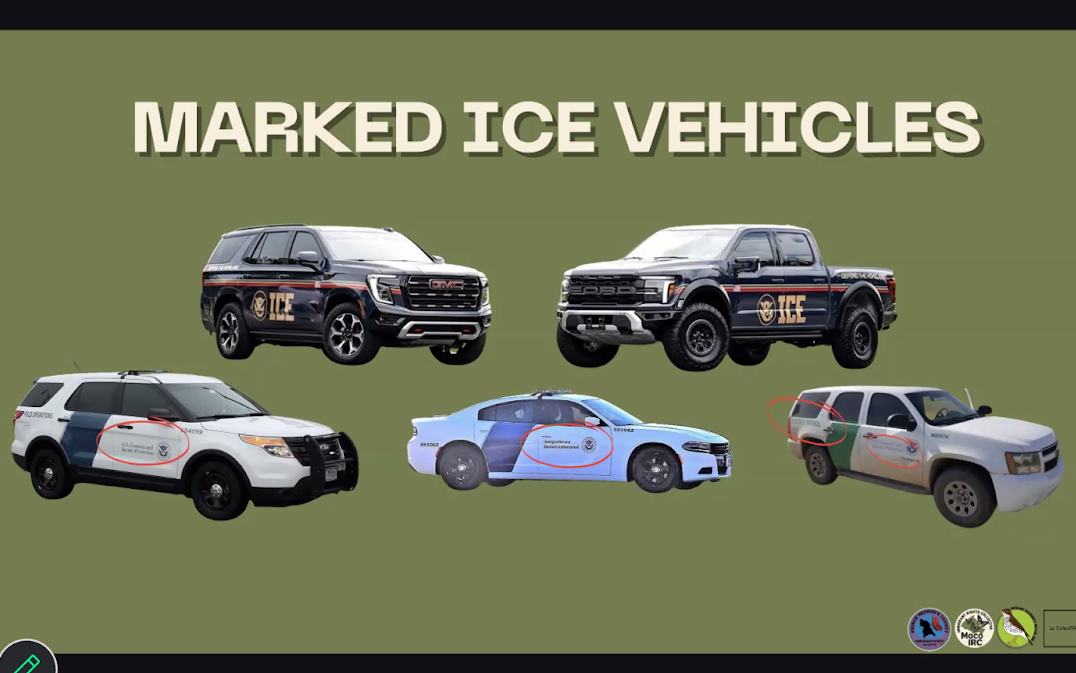
Sanctuary Streets Baltimore, Baltimore Rapid Response Network (26 Feb. 2026). ICE Watch Bystander Training [Webinar]. Zoom.
Unmarked vehicles typically have the following features, makes, and models:

States at the Core, Protect Rogers Park. “Documenting and Responding to ICE 12/03”, https://mpls-synod.org/wp-content/uploads/Documenting-and-Responding-to-ICE-12_03.pdf
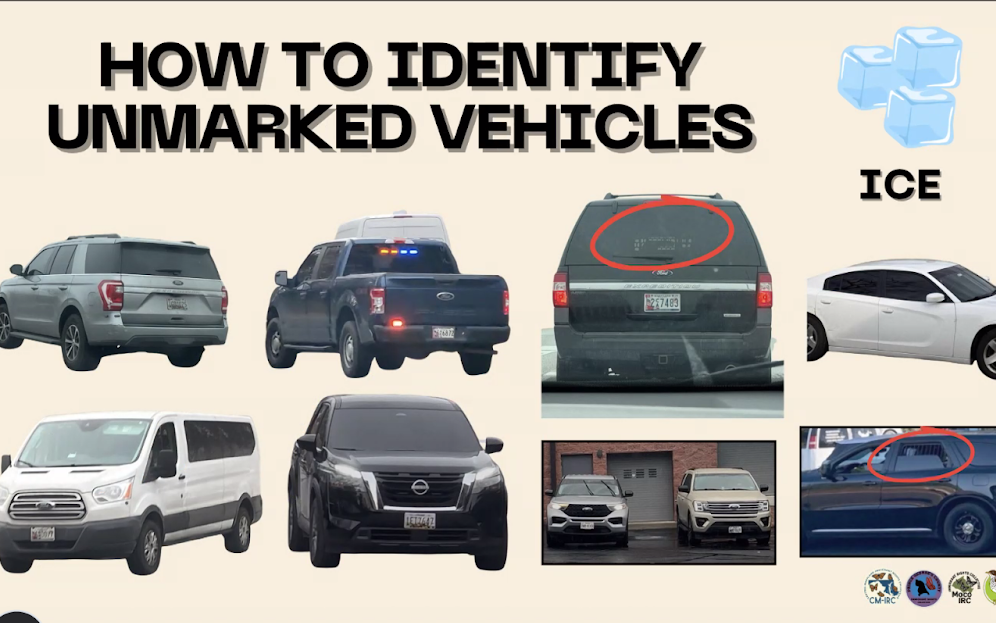
Sanctuary Streets Baltimore, Baltimore Rapid Response Network (26 Feb. 2026). ICE Watch Bystander Training [Webinar]. Zoom.
Identifying ICE Agents
Identifying ICE agents can be difficult. Uniforms can help identify what agency an agent is from.
- DHS is allowing certain law enforcement components from the DOJ to carry out the functions of an immigration agent.
- ICE usually wears plain clothing with black bulletproof vests. Oftentimes, it says “POLICE” on the front or back, but there may be no identifying markers.
- Look for “POLICE ICE”, “POLICE HOMELAND SECURITY/HSI/DHS”, “ERO”, “BORDER PATROL/CBP”, “FBI”, “DEA”, “ATF”, or “U.S MARSHALL”.
If you can safely approach and film them, ask:
- What department or agency they’re from
- To see ID, a business card, or a badge; federal agents must identify themselves
- If they have a signed judicial warrant
- For agents’ names and titles
- Why they’re there and if they’re conducting immigration enforcement
Some marked uniforms you might see associated with the agencies from the DOJ and DHS who may carry out the functions of an immigration agent include:
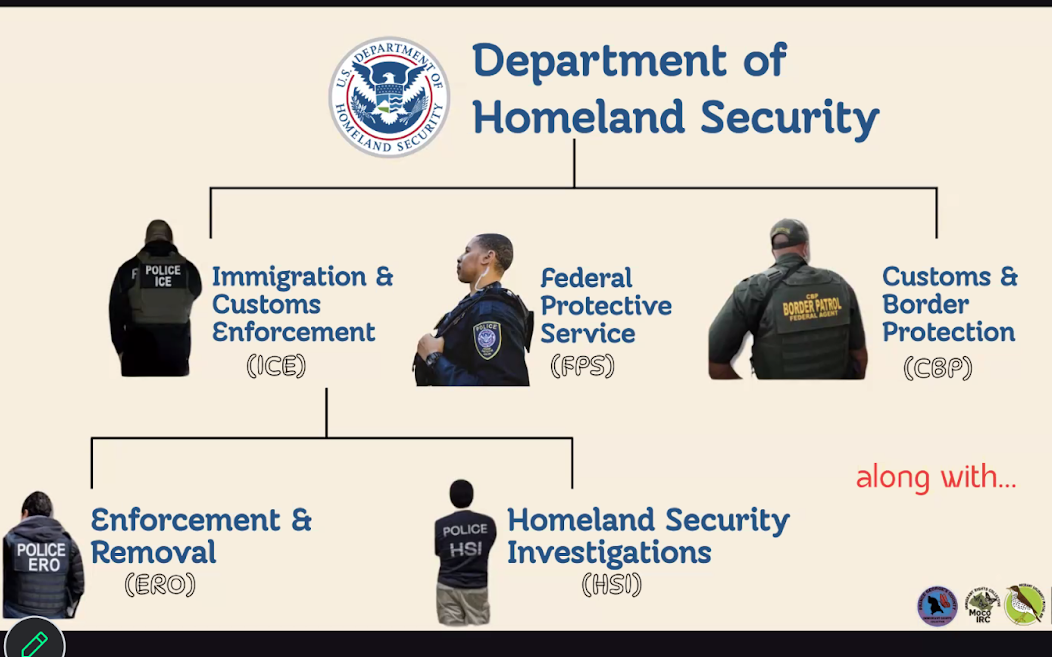
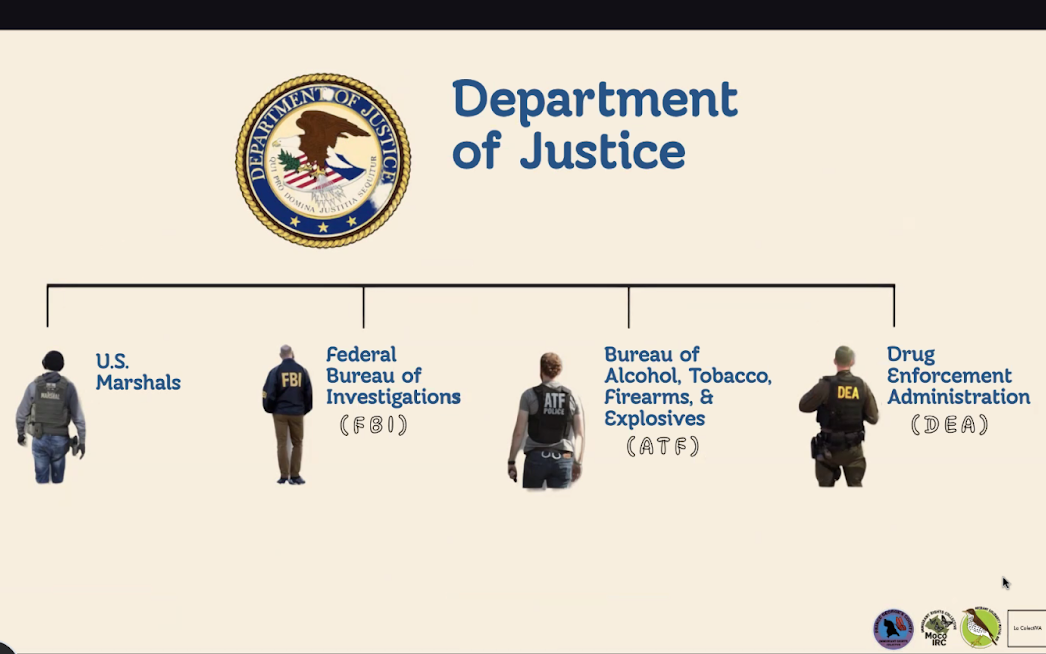
Sanctuary Streets Baltimore, Baltimore Rapid Response Network (26 Feb. 2026). ICE Watch Bystander Training [Webinar]. Zoom.
Identifying Local Police
Sometimes ICE will pretend to be police. A Columbia University student was detained on February 26th when ICE agents who misrepresented themselves as local police gained access to a residential building. ICE may ask questions, claim to have found a lost ID, or claim that you’re a suspect in a crime. In person, they might do this to get inside a residential space, make an arrest, obtain info, or locate the person they’re attempting to arrest.
Know the difference between federal agents who may be conducting immigration enforcement and local police. Local police wear distinctive uniforms with identifying insignias. The following are patches belonging to Maryland state police.


“Baltimore Police Department.” Wikipedia: The Free Encyclopedia, Wikimedia Foundation, Last Modified 2 Mar. 2026, https://en.wikipedia.org/wiki/Baltimore_Police_Department. Accessed 26 Mar. 2026.
“Baltimore County Police Department.” Wikipedia: The Free Encyclopedia, Wikimedia Foundation, Last Modified 22 Feb. 2026, https://en.wikipedia.org/wiki/Baltimore_County_Police_Department. Accessed 26 Mar. 2026.
Both local police and ICE need a Campus Safety escort on campus. If they don’t have one, contact campus safety.
Step 1: SALUTE
If you are the one of the first people on scene, do a SALUTE report. This will help you get a sighting verified and document ICE activity. The SALUTE acronym stands for:
- Size – Number of agents and vehicles
- Actions – What are they doing? What have they been doing?
- Location – Where are they now? Give an exact address and landmark.
- Uniform – What are they wearing? Plain clothes? Badges? Uniforms?
- Time & date – What’s the date? That time did they arrive? When did they leave?
- Equipment – What equipment do they have? What kind of weapons? Body armor? How many of each type of equipment can you see?
Form an initial assessment of the scene. Are agents engaging in active enforcement or are they idly present? Is there immediate risk to yourself or others?
Step 2: Verify
This step is extremely important! To avoid spreading misinformation, try to confirm that the people you see are attempting to carry out the functions of an immigration agent before you alert others.
- If it is safe for you to do so, try to get a closer look and ask questions
- Get clear photos or videos to send to community verifiers along with your SALUTE report
- Get the sighting peer reviewed
Step 3: Alert
Once the sighting is verified, sound the alarm.
- Contact Campus Safety by phone (410-337-6112) or Campus Shield app
- Contact a campus watch group with the verified sighting
If using a whistle, move a significant distance away so others can hear what’s happening on-scene. Whistles can cause confusion for people who aren’t familiar with the whistle codes. Use it sparingly. Prioritize yelling.
- ICE is nearby: Three short whistle blasts
- ICE is detaining someone: Three long whistle blasts
Call a hotline:
- ACLU of Maryland Immigrants’ Defense Tip Form (https://action.aclu.org/legal-intake/aclu-md-immigrants-form)
- CASA hotline – use in cases of active ICE harassment and detention (1-888-214-6016)
- MSMA / Migrant Solidarity Mutual Aid Network hotline – use in cases of active ICE harassment and detention (202-335-1183)
Step 4: Act
This step means different things for different people. If you’re an international student, immigrant, or other at-risk community, this is your time to get to safety.
If you can act in defense of others, consider doing so. Practice situational awareness and use your environment to your advantage. Put obstacles between yourself and ICE. NEVER INTERACT WITH ICE ALONE. Ideally, work in groups of 3 or more:
- Recorder: Record as long as it is safe for you to do so. Narrate your actions as well as the actions of agents, detainees, and other observers. Focus the camera on ICE.
- Supporter: Shout know-your-rights info. To detainees, ask for name and an emergency contact.
- Monitor: Take note of everything that’s happening. Help direct people to engage safely; remind them of their rights and responsibilities as constitutional observers.
DO:
- Carry proof of status and local ID
- Make sure a trusted friend or relative has relevant information
- Keep distance of at least 10ft and back up if necessary
- Narrate your actions
- Try to remain calm
- Hands up and empty (except for a phone if you choose to record)
- If in a vehicle, lock doors, get hands off the steering wheel, roll up windows (only roll down the window if asked to do so; you can do so partially)
- If arriving at an active scene in a vehicle, park a block away or around a corner so ICE cannot easily identify your vehicle
DON’T:
- Run away; it can be used as reason to detain you
- Sign anything or answer questions
- Carry weapons or illicit substances or interact with an agent while intoxicated
- Physically interfere with an agent’s activity
- Lie to agents
- Use aggressive verbal or physical behavior
Filming ICE collects evidence that helps expose law enforcement abuses and could help a detainee’s legal case.
- Assess the situation before you film
- Film horizontally with the camera trained on the agents and their vehicles
- Pan the camera slowly to show the surrounding area
- Make it one continuous recording
- Film openly
- You can continue recording if asked not to
- Save the original unaltered file
- Determine if you need to protect the identity of other people (observers or detainees) in the video
- Hold the phone securely, close to your chest with both hands
- Do not go live on social media
Step 5: Community Care
After an encounter with ICE, check in with others at the scene and the community. Make sure everyone remaining at the scene is unharmed, talk to witnesses, and distribute resources. Scenes like this can be extremely stressful, especially in cases where someone has been detained. Use trauma-informed practices.
- Be tactful
- Don’t force someone to share their story
- Don’t make promises that can’t be kept
- Affirm their agency, personhood, and dignity while promoting safety, calm, and connectedness
- Say things like “I’m here with you”, “you’re not alone”, “I can stay with you if you’d like”, and “how can I support you?”
- Practice grounding techniques, breathing exercises, and self compassion. Take care of your physical and mental health too!
Featured Image Source: Sanctuary Streets Baltimore, Baltimore Rapid Response Network (26 Feb. 2026). ICE Watch Bystander Training [Webinar]. Zoom.





Be First to Comment