

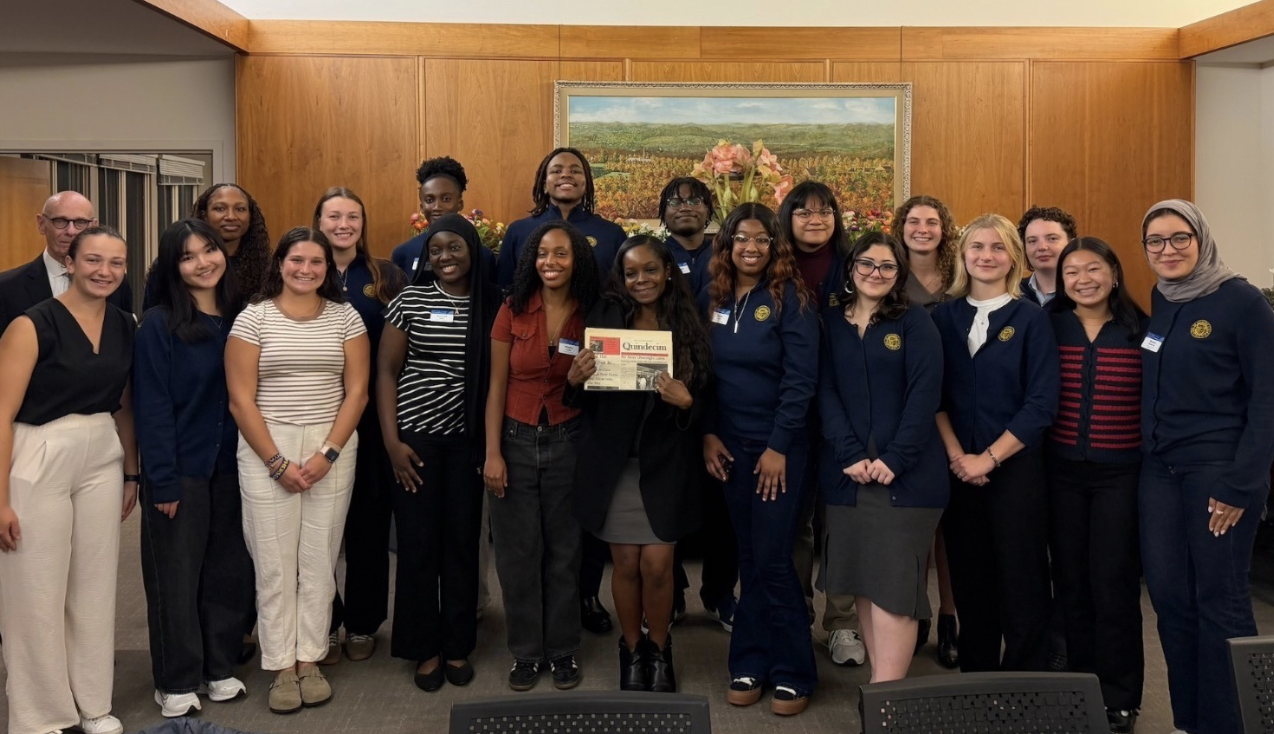
Before stints at The Baltimore Sun, The Baltimore Banner, and Chicago Sun Times, Erica Green’s first encounter with reporting was as its subject rather than its storyteller. With her mother centered in the case of a drug deal turned death, Green found herself as a second casualty to her mother’s crime. The jury convicted Green’s mother, and like too many kids in this country, Green was left to be forgotten in the fog of foster care. However, these early experiences directed Erica Green to her journalistic ethic and inspiration, which she employs as the New York Times’ White House Correspondent. As she relayed to the Arsht Presidential Diplomats in the first installment of their speaker series on September 28th, “I wanted to cover kids like me.”
Learning how to construct an article under the counsel of current Quindecim advisor, David Zurawik, Erica Green’s rapacity for reporting led her to former university president Sanford J. Ungar. Demanding the creation of a communications department, Green is, in part, responsible for the existence and endurance of the media studies major today. In conjunction with these new courses, she honed her skills as the Quindecim’s news editor, and later, assistant managing editor. Green first got into political pieces with the Q, covering topics like Michael Steele’s Senate Campaign, Martin O’Malley’s transition from Baltimore mayor to Maryland governor, and the pitfalls of the Bush presidency. She even chronicled a disquisition from former New York Times White House Correspondent, David Sanger, a position she would succeed to seventeen years later.
Composing a specialty for herself in evaluating education policy, Green was a brilliant writer at The Baltimore Sun. Not even a decade after graduating from Goucher, Green was part of a team at The Sun that covered the tragic 2015 killing of Freddie Grey and the consequent riots, which garnered her recognition as a finalist for the 2016 Pulitzer Prize. Despite Green’s lean toward political pieces, she never considered herself a political reporter, asserting instead that “one thing I do not compromise on is what is right and wrong,” and with her history in foster homes, education policy was her outlet in advocating for children. After seven years at The Sun and despite her opposition to documenting the 2016 election and its effects, the New York Times scouted her specifically in 2017 to write about former Education Secretary Betsy DeVos.
Her lean toward education led her to cover human rights crises among children like discriminatory educational outcomes for Native American students, disproportionate disciplining of Black girls in school, and secret and illegal suspensions of special education students. Alongside Katie Benner, she exposed abuse and academic fraud at the T.M. Landry College Preparatory Academy in Louisiana.
Drawn in by her excellence in education reporting, the New York Times recruited as a White House Correspondent, covering then-president Joe Biden. Green, given the opportunity to accompany former Vice President Kamala Harris to London in the fall of 2023, she saw something in the first woman in the White House that others did not. Alongside Harris and Prime Minister Rishi Sunak, discussing pthe Israel-Hamas conflict, Erica Green saw a candidate who was competent, compelling, and completely written off by the New York Times. Green hitched herself to Harris. So on July 21st, 2024, when President Joe Biden dropped out of the presidential race, leaving an endorsement for Harris, Erica Green was the obvious choice for campaign coverage. Through the 107 days of Kamala Harris’s candidacy, Green was there, all the
way to election night at Howard University. Upon the news of Harris’s loss, Green interviews Howard student who had crowded around their historically Black university, believing they would see a Black woman enter the country’s highest office for the first time in history. Green recalled the most chilling response: “this is what this country is.” Still reeling off the high of election night, The Times asked her to film a video piece entitled “What Kamala Harris’s Loss Means to Black Women. Addressing the Arsht Diplomats, Green recounted her exhaustion from both the long night and the disappointment of the election, Green was visibly upset and short in her answers, and is, to this day, shocked that The Times released it.
By Via Rooney ‘ 29







Be First to Comment